When the Lions Women land in New Zealand next year for the inaugural Tour, it is fair to say preparation will be meticulous, from strength and conditioning to nutrition.
Four decades ago when Great Britain welcomed France to Richmond for the very first women’s international rugby match on UK shores, the idea of monitoring food intake was so unheard of that some of the team prepared for the encounter with a Friday night curry.
That first encounter on April 19, 1986, was a step into the unknown only made possible by a group of determined women whose resolve is the main reason that women’s rugby is filling stadia and smashing attendance records every week.
From conversations around kitchen tables by those early pioneers, history was made in south west London as France took on a GB team featuring some of the great names of women’s rugby.
But while the game laid the platform for both the Six Nations and all women’s rugby in Europe, it is fair to say that the home team’s preparations were far from optimal.
Great Britain’s Amanda Bennett, who later went onto represent Wales, recalled: “We had to be at Richmond Rugby Club on the 19th April. We had been told to get there the day before.
“So the night before I slept on (teammate) Suzy Hill’s floor because she lived in London. We couldn’t afford hotels or anything like that and it was up to us. There was no nutrition so we had a curry the night before the game!”
The team was selected after a pair of trials at Finchley Rugby Club and Oxford University, with notices put up at clubs around the country to invite anyone who fancied their chances to come along.
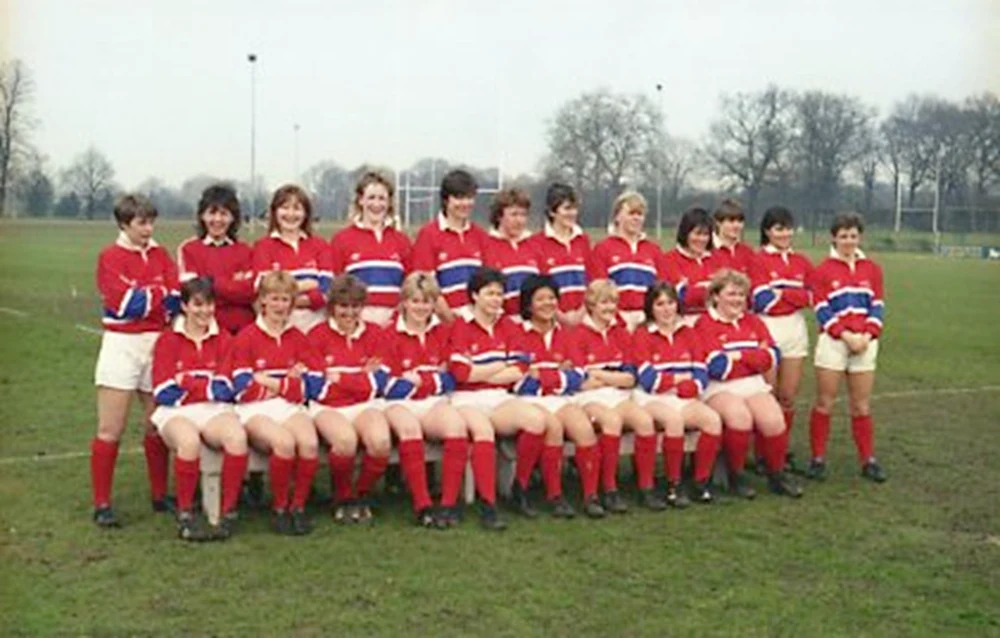
They were whittled down before a final squad representing England, Ireland, Scotland and Wales was selected, captained by Carol Isherwood, who was joined by the likes of Bennett, future World Cup-winning captain Karen Almond and Wales legend Liza Burgess.
And yet even the previous day, while the team were getting in a final training session – only their second – work was going on behind the scenes to ensure that the French would make it.
In the pre-internet days, long before mobile phones, there was legitimate concern that they might not show. And even when they did, team manager Fiona Barnet found herself sprinting across London to welcome them.
Isherwood took up the story: “The French hadn’t confirmed they were coming. We were training on the Friday night at Rosslyn Park and a guy came from the clubhouse asking if anyone called Isherwood was there.
“I came rushing in and it was Fiona Barnet, the team manager on the phone. She was going to meet the French. We thought they were going to Heathrow but they actually arrived at Gatwick. She had to scurry across to get them and get them into London.
“We didn’t know the protocols of how it all worked, who pays for what. We just assumed they would pay for themselves and we would get them accommodation. They were expecting a coach at the airport and we certainly didn’t have the money for one.
“I think Fiona said the coach was at Heathrow and had to leave. I did apologise to the French at the 2017 World Cup, telling (then-FFR vice president) Serge Simon ‘je suis désolée but I had to blag that one!’.”
This first international encounter was something of a wake-up call for GB. Even with some future greats among their number, they were up against a French side that was far better drilled, having played international rugby for four years previous, and ran out deserving 14-8 winners.
Given how much work they had done just to get the game on, little wonder that the defeat only spurred on the Great Britain team to ensure that they would one day get the better of their rivals from across the Channel.
It took three more years, but in 1989, they finally did so, triumphing 13-0 at Rosslyn Park in the team’s penultimate match.
Almond said: “We played the first game and we were very much on the back foot. France were very strong, they had been playing a lot longer and were more organised. I think it was a bit of a wake-up call.
“We had made it to this level but we were not good enough to beat other countries so we had to step our game up.
“I think it was good to get in at the international level that early because we went away and knew we had to get fitter, our skills had to be better, it gave us a really big focus to improve and we finally beat France three years later. It paid off in the end.”
As well as organising everything themselves, the team also had to put their hands in their pockets for the many expenses that came with this step into international rugby – no small matter for a team made up of a number of students or recent graduates.
The players provided their own shorts, while their socks and shirt – a specially-designed drill cotton number – set them back £12.
Isherwood joked: “We took half an hour to make a decision to have a game and then spent the rest of the meeting designing the shirt. It looks remarkably like a rugby league shirt, I think that was my input.”
By playing the game in Richmond, just up the road from Twickenham where the County Championship final was being held on the same day, they were able to get some coverage of the encounter, even if media interest in the women’s game was of a different approach to today.
Bennett said: “The publicity at the time wasn’t necessarily sports journalism. You might have had the broadsheets who would talk about the person behind the performance. What do you do on weekends? Do you have a boyfriend?
“And then the red tops would be talking about the body under the shirt: How do you keep yourself fit? Are there certain bits that can get hurt? There was that sort of journalism, we had to tolerate it.
“But if it got us some kind of exposure and awareness that there were women playing rugby, we could live with it.”
That awareness led to a first international meeting between England and Wales the following year in Pontypool, Almond and Bennett going head-to-head at fly-half, having combined for GB in that debut.
Even with the advent of individual home nations teams – Scotland and Ireland followed later, featuring some of the GB contingent – Great Britain continued over the next three years, playing eight matches in all both at home and in France, including a European Championship in 1988 where they played three matches on back-to-back days in Bourg-en-Bresse.
The French proved the toughest nut to crack, but they got the better of the Netherlands and Italy in that tournament, and thanks to Chris Gurney, a member of the team, information about those games has been meticulously gathered, providing evidence of the early pioneers.
Beyond the players, the support staff at the time – fulfilling very different roles to a professional backroom staff – deserve recognition too, administrator Rosie Golby, selector Alan Christie and coaches Jim Greenwood, Steve Dowling and the late Stefan Czerpak, in particular.
Without them, it is fair to say that women’s rugby as we know it today would not exist.
And it all came from a single-minded approach. No moaning or whinging at the obstacles in their way, just an acceptance that if these women did not do it, no one else would.
As Bennett succinctly put it: “Well-behaved women seldom make history. We were women who were misbehaving.”
A group of misbehaving women who not only made history but changed the present.